

The 7 Levels of AI, Their Evolution, and Their Role in Trucking and Transportation
Artificial intelligence has become one of the most buzzworthy topics in business circles and with good reason. PwC’s Global Artificial Intelligence Study indicates that AI could make a $15.7 trillion contribution to the global economy by 2030 and that local economies will experience a 26% boost in their GDP by the same year.
In the business world, organizations are already using AI to automate processes, analyze data, improve decision-making, and generally streamline operations to save time and money.
But what about the trucking and transportation industries? Trucks move about 72.6% of freight in the United States as measured by weight. The trucking industry employs 8.4 million people and contributes more than $792 billion to the U.S. GDP. It stands to reason that AI could be an accelerator for the industry, unlocking benefits and helping streamline trucking activity.
I’ve been researching and working on solving complex challenges with sophisticated math toolsets in the trucking and transportation space for 40-plus years, first as a professor and lecturer at Princeton, the Massachusetts Institute of Technology, and Rutgers, and now as a co-founder of Optimal Dynamics.
The application of AI in the trucking and transportation industry has evolved over time, and Optimal Dynamics has played a pioneering role by creating real-world applications for AI within the transportation sector. This article explores what I know of AI’s evolution from simple, rule-based logic to sophisticated pattern recognition, machine learning, and decision-making. It also highlights how Optimal Dynamics has played a leadership role in the application of AI for trucking and transportation companies — and how AI works in our platform today.
The Foundations of AI in Trucking
The trucking and transportation industry is currently operating in what’s known as “Freight 4.0.” Freight 4.0 follows Freight 1.0 (the use of water and steam to transport goods), 2.0 (the technical revolution powered by electricity and machines), and 3.0 (the digital revolution that started with computers in the 1970s).
Freight 4.0 builds on the age of the computer by incorporating:
- The Internet of Things: The networking of physical devices via the Internet.
- Blockchain: Technology that’s revolutionizing the way transactions are processed.
- Big data: The analysis of large amounts of information to identify patterns and insights.
- Artificial intelligence and machine learning: Innovations used to automate processes and make complex decisions.
There’s some overlap between the different eras of freight. For example, research and work on AI dates back to the 1960s and 1970s, a time when Freight 3.0 was still just emerging. Below, explore the evolution of AI from that starting point in the mid-20th century through where AI stands today.
The 7 Levels of AI
This is my own classification of the levels of AI, and it is subject to updating and change. I first wrote about these levels of AI on LinkedIn, and then I provided a brief update just a few months later. Most recently, I’ve substantially updated my thinking on Level 7 to reflect how my view has shifted in the era of large language models. Here’s a look at my thinking on the different levels of AI, where we are right now, and where we may go in the future.
Level 1: Rule-Based Logic
There’s nothing new about the concept of AI. In the 1960s and 1970s, AI was going to take over the world (according to experts, the media, etc.). This first iteration of AI represented simple behaviors and was built on what I think of as “rule-based learning.” That initial iteration of AI did not indeed take over the world, but rule-based logic remains an important component of how AI is used in the 21st century.
Levels 2, 3, and 4: Supervised Machine Learning
The second, third, and fourth levels of AI can all be lumped into a category I think of as “supervised machine learning.” Why separate these seemingly similar concepts into different levels? Because they are each unique and emerged at different points in history. Here’s a timeline:
- Level 2: Level 2 is basic machine learning, including “simple” models that relate quantitative inputs to quantitative outputs, often using relatively small neural networks. This was the first evolution beyond rule-based logic.
- Level 3: Level 3, pattern recognition, was the first use of deep neural networks. When Level 3 emerged around 2010, it represented a giant leap forward for AI. Never before did we have the ability to analyze patterns as advanced and complex as what Level 3 can help us recognize.
- Level 4: Level 4 marks the introduction of large language models. Large language models are much more complex than pattern recognition models, mostly because these networks include up to 1 trillion parameters. Level 4 requires elaborate and sophisticated pre-procesing of data. For example, a single word requires up to 12,000 individual descriptors.
Levels 2–4 are almost like cousins — they are part of the same machine-learning family but unique enough in time and capabilities to be categorized separately.
Level 5: Deterministic Behavior/Static Optimization
Level 5 is classic deterministic optimization, which means specifying a model of a physical problem and then using powerful algorithms to identify the optimal (or near-optimal) solutions. These models require a great deal of work, and they can only solve a single problem or a narrow class of problems with the same structure. That said, Level 5 will always outperform what a human can accomplish alone.
Level 6: Sequential Decision Problems
Level 6 is also in the optimization family alongside Level 5, but it applies to sequential decision problems that represent a much broader class of problems. We must specify the problem’s physics or dynamics for the AI to perform. The AI can then automate any process for which it has been properly engineered.
This is a huge step toward true intelligence. A computer can outperform a solution most of the time, but that outcome is not guaranteed.
Level 7: Decision-Native Agentic Systems
I originally called Level 7 the “Finger of God” — a placeholder for the science-fiction version of AI that would replace people, cure cancer, or threaten society. That was the right framing when I first wrote this piece. The arrival of large language models has since changed how I think about it.
LLMs are genuinely transformative. They can perform a wide range of complex tasks from learned behaviors, and they create powerful new ways for humans to interact with computers. But they cannot make decisions. Decision-making is a different kind of problem, one that lives in the world of optimization, and building bigger language models won’t get us there.
The real next generation of AI, in my view, is what happens when you combine the two. LLMs handle what they’re good at: ingesting unstructured information, estimating values from messy inputs, and helping people in the field interpret and adopt what the system recommends. Optimization handles what it’s good at: making decisions, especially the sequential decision problems at the heart of Levels 5 and 6.
At Optimal Dynamics, we call this idea decision-native agentic systems (DNAS).
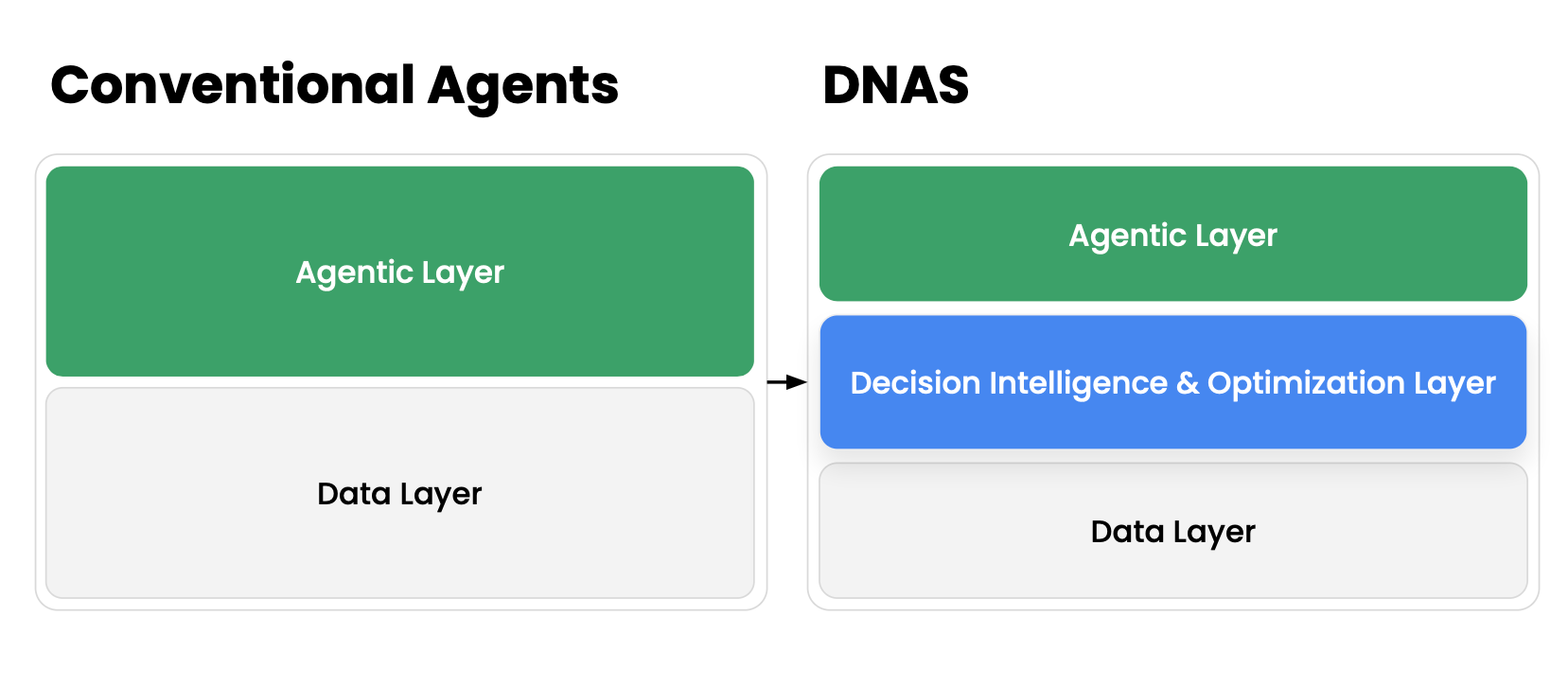
Three agent types do the work:
- Information ingestion and estimation agents gather data and estimate the values we need.
- Decision agents make the actual decisions using optimization.
- Implementation agents help the decisions land in the field.
The new Level 7 brings these capabilities together into a single system, with each tool doing the work it was built for. The result is decision-making that no single model can produce on its own, and a foundation capable of running real operations in the field.
Where Will AI Take Us Next?
We’ve come a long way from the simple, rule-based systems that characterized the early days of AI in the trucking and transportation industry. The most interesting work ahead is in decision-native agentic systems, which put language models and optimization to work alongside each other so that each tool does the part of the job it was built for. And what’s mentioned above is only scratching the surface of how AI is currently being used in this space.
At Optimal Dynamics, we maximize the application of AI in its most advanced form to solve real-world problems for trucking and transportation companies, everything from planning around unknown variables and complex business needs to dynamic automation for execution (including building ideal tours and making the best dispatch decisions) to identifying and bidding on the lanes that are uniquely valuable to your business.
You can experience how AI is transforming this industry right now. Schedule an Optimal Dynamics demo to see firsthand how AI can impact your organization’s operations by maximizing performance and profitability.
About Warren Powell
Warren, Co-founder and Chief Innovation Officer at Optimal Dynamics, is a leading expert in computational stochastic optimization and decision-making under uncertainty, with applications in transportation, logistics, and energy. A renowned author and award recipient, his work bridges theory and real-world impact.