

Meet Scale: The Decision-Native Agentic System Built to Secure the Right Freight for Truckload Carriers
Trucking companies make a lot of important decisions in a day, but the one that matters most is whether to accept or reject a tender. Most companies are making that decision the hard way: reactively, with the clock running down and no real time to weigh the downstream trade-offs.
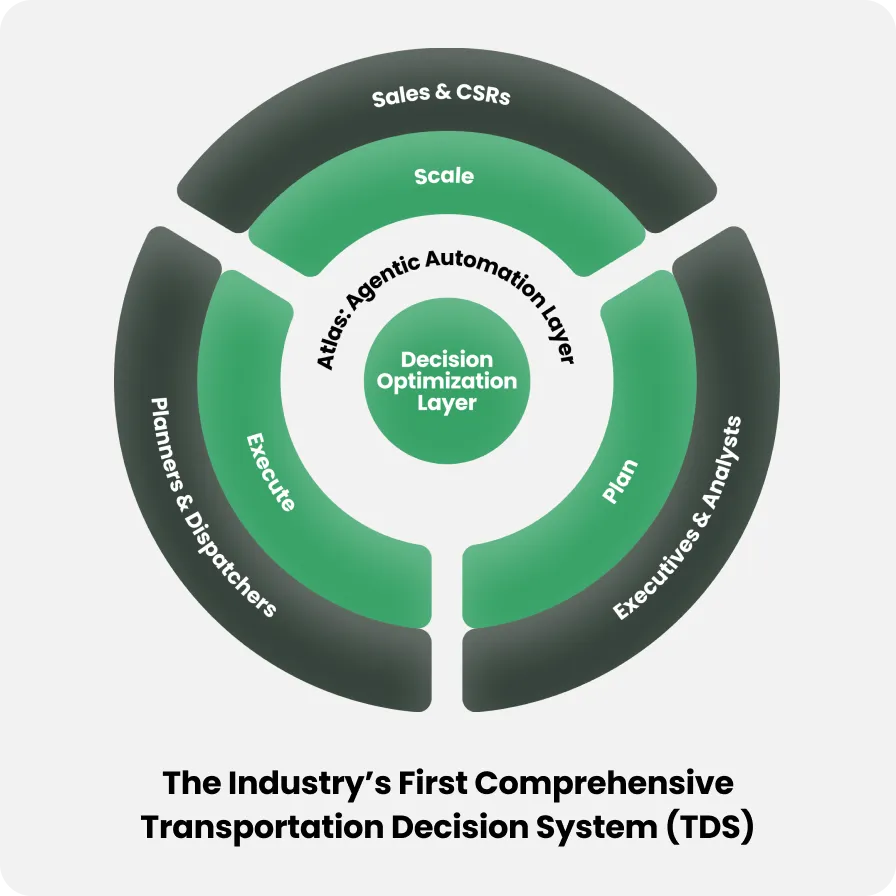
That’s the problem Scale by Optimal Dynamics solves. The industry’s first Decision-Native Agentic System (DNAS), Scale secures the right freight for your network, automatically and through the lens of the commitments and margins you already manage.
We recently hosted a live walkthrough of Scale and its capabilities with Jake Dettmer, Senior Vice President of Product, and Ben Marks, Senior Director of Solution Sales Engineering. Together, they ran through a product demo and shared how Scale impacts day-to-day carrier operations.
Here’s a recap of all that was discussed, including 6 key takeaways from the session.
1. The Hardest Freight Decisions Happen With the Least Information
On a chart, the lifecycle of an order looks straightforward: a customer gives you freight, you quote it, you move it, and you get paid. Jake made the point that the clean version on a chart hides what he calls the “messy middle” of a transaction.
The messy middle is the decision to accept or reject the load. It’s where trucking companies decide what freight fits the network, when to let a routing guide fail, and when to hold customers accountable to what’s on file. It’s also where fleets have the least information to work with.
“By the time you have perfect information, the decision no longer matters.” — Jake Dettmer, SVP of Product, Optimal Dynamics
If you wait for certainty, you’ve waited too long. Act early, and you’re left to make guesses. Either way, the most important decision gets made on the worst information you’ll have all day.
Customer Service Reps (CSRs) bear the brunt of this challenge. Two strong CSRs can look at the same load and make opposite calls, both defensible, because they’re each working one tender at a time with no insight into this week’s network demand or the health of the commitments that a load touches.
2. Conventional AI Agents Treat Symptoms (Not Problems)
AI agents can do a lot. They can read emails, pull market rates and history, generate quotes, and book loads.
But conventional agents are inherently reactive. They wait for instructions — then follow whatever workflow or rule they’ve been given. They are not working toward an outcome. A conventional agent has no view of the network as a whole, so every action is taken on an island. One agent may book a load with no idea what the agent two desks over just did.
Rather than solving problems in the long-term, conventional agents treat symptoms in the short-term. Your network may look better for an afternoon, but underlying issues will break something further downstream.
“You can start to feel better about a decision that’s made. But now there’s a correlated symptom that occurs, because you’ve never actually treated the problem.” — Jake Dettmer, SVP of Product, Optimal Dynamics
In response, humans implement new rules to treat the proliferating symptoms. Each new workflow spawns additional workflows. The agents remain busy, but your network continues to drift — because decisions are made based on convenience rather than what’s best for the network.
Solving the problem requires information that helps agents understand the network and the ramifications of their decisions.
3. One Source of Truth for Your Customer Commitments
Commitments typically live in spreadsheets, in PDFs, buried in email, or inside someone’s head. When the information is scattered like that, it can’t help you make the decision at hand.
During the walkthrough, Ben uploaded a live award file. Scale can take almost any file format, including Excel, PDF, and plain text. Then, Atlas, our language model, reads the file and hands it back to you for approval. When something’s missing (like a customer ID), it tells you. The result is a commitment backbone that lays out every contract and its health score.
As awards come into the network and roll off, Scale flags the contracts that are at risk or underperforming and warns you which ones are about to expire. Users can also ask Atlas plain questions. Ben asked the obvious one: What's the overall health of my commitments?
“Four out of five contracts are healthy. We have 39 sitting at risk or underperforming. This is where we now have a call to action.” — Ben Marks, Sr. Director, Solution Sales Engineering, Optimal Dynamics
This health score is a call to action because it highlights the 39 contracts that are slipping (and the customers behind them). You can drill into the most-impacted lanes to see where the damage is concentrated, and you know exactly who to call at a time when you can still do something about it.
4. Scale Decides Through the Lens of Your Whole Network
Here’s the trap: a load comes in on brokerage, gets covered on brokerage, and nobody asks whether that was the right home for it. You might have an asset sitting in exactly the right spot to take it cheaper, but you’d never know — because those decisions are made one load at a time.
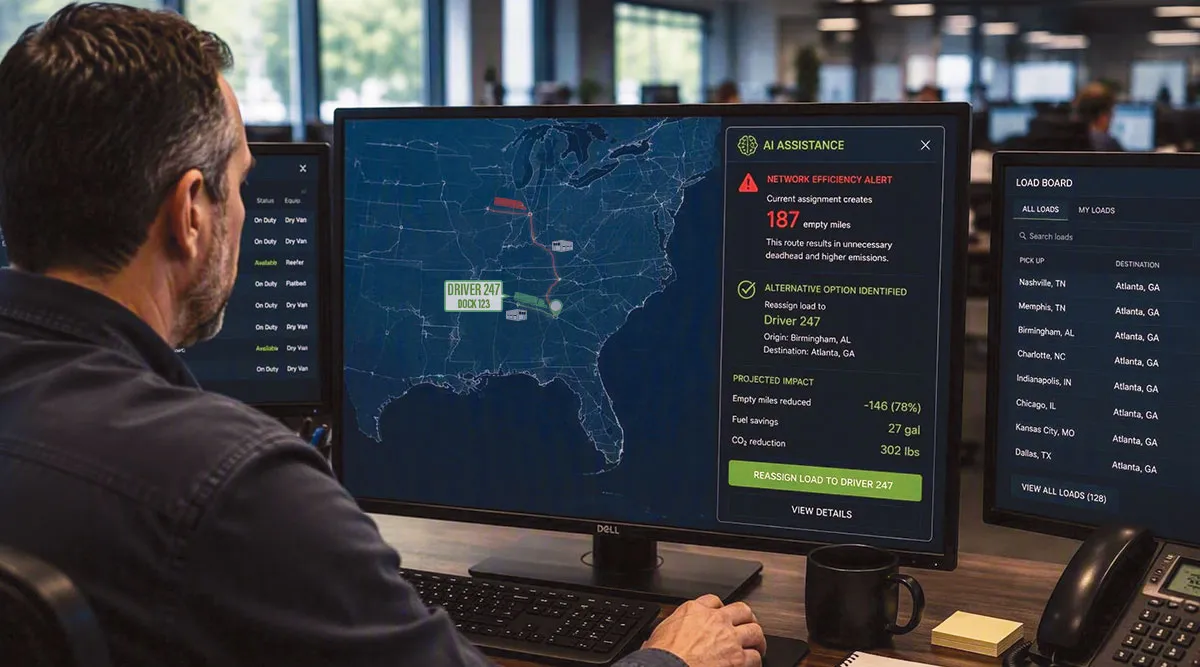
Scale looks at the whole board instead. During the walkthrough, Ben showed how Scale weighs each load against the state of the network: where your trucks are, what your margins look like, and the flexibility you set during the commitment upload.
“This load is currently on brokerage. We have a better asset available to move this in your non-asset arm.” — Ben Marks, Sr. Director, Solution Sales Engineering, Optimal Dynamics
And it works both ways. When your network’s out of balance, a load sitting on an asset gets flagged to sell on brokerage so you can reposition the truck.
Through a two-way TMS integration, Ben reallocated every flagged load in two clicks. Scale made the TMS calls and mimicked the process the team already runs, so work that used to be a stack of manual keystrokes became a decision you simply approve.
5. Balancing Should Look Forward (Not Back)
Most freight network balance reporting tells you what’s already happened. For example, you find out on Tuesday that Charlotte ran heavy the previous week. This is long after you could have done anything about it.
Scale’s Network Manager is different. It’s a balance map that shows where you stand right now: balanced in Dallas, balanced in Nashville, a surplus in Charlotte with eight trucks coming in and twelve going out. You can see the planned and unplanned loads in each market, rather than a single number.
“We can even go out into the future ... we’re looking out into the future to help balance the network and make decisions through the light of our forecast.” — Ben Marks, Sr. Director, Solution Sales Engineering, Optimal Dynamics
In the walkthrough, Ben jumped to June 12 and read the map’s projection: a five-truck surplus in Indianapolis, seven planned loads, two unplanned, with drivers projected into the market. This is positioning for demand you can see coming, while weighing it against your commitments and margins. You can take action to correct an imbalance in advance rather than learn about it after the fact.
6. Decision Optimization Is What Drives Profitability
Scale’s agents sit atop a decision optimization engine that emerged from 40-plus years of research conducted at Princeton. Jake used a chess analogy to make the point. There are 400 possible moves to start a chess match, then 9,000, then 150,000, and it continues climbing past 100 million a few moves in.
A large language model (LLM) alone can’t keep up with the iterations. That’s why ChatGPT can lose a chess match to an Atari from the 1980s. But when you add a problem-solving decision optimization layer, the agent stops guessing and starts optimizing toward a specific outcome.
You see that logic in how Scale’s agents behave. An agent trying to win freight in a market where its odds are low deprecates itself and hands the work to a more useful action. That means you’re never dedicating resources to work that’s not going to pay off.
“The outcome of that is profitability. We are always looking at these decisions ... as a look forward into what’s the marginal profitability that we can drive in the moment.” — Jake Dettmer, SVP of Product, Optimal Dynamics
Scale is always asking what the next decision is worth right now: the value of one more load, one more truck, one more reposition, measured against your commitments and your margins. That’s the difference between automation that just stays busy and automation that makes money.
Confident Decisions Made With a Full-Network View
For too long, an operator’s reality has been making important decisions reactively, with partial information, and while the clock is running.
Scale changes that reality. With your commitments in one place, your loads allocated against the state of the network, and a forecast you can act on before the imbalance shows up, operators can now make the accept-reject decision with confidence.
Ready to learn more about network management with Optimal Dynamics? Get in touch to see Scale in action.
Frequently Asked Questions
What is Scale by Optimal Dynamics?
Scale is the industry's first Decision-Native Agentic System (DNAS), a freight procurement and network management solution that combines decision optimization with autonomous AI agents to help asset-based carriers accept the right freight, balance their networks, keep customer commitments and protect profitability. Unlike conventional AI agents that follow rules, Scale evaluates every decision through the lens of your entire network.
What is a Decision-Native Agentic System?
A Decision-Native Agentic System is an AI platform where the decision optimization engine, not a set of rules or workflows, drives what agents do. In Scale, the optimization engine determines which freight to accept or reject, which loads to reposition, and where network imbalances are forming with an eye on the needs of the entire network. Agents then execute those decisions autonomously across load boards, email, EDI, and direct channels.
How is Scale different from conventional AI agents?
Conventional AI agents are reactive — they wait for instructions and execute tasks one at a time with no view of the broader network. Scale's agents are proactive. They operate continuously, evaluate decisions against network-wide commitments and margins, and self-deprecate when a better action is available. The result is automation that optimizes toward an outcome, not just automation that stays busy.
How does Scale make accept/reject decisions?
Scale evaluates each load against the current state of the network — truck positions, commitment health, margin targets, and balance across markets. Rather than scoring a load in isolation, it calculates the marginal profitability of accepting it relative to everything else happening in the network at that moment. Decisions are made continuously and automatically, with human approval available at every step.
How does Scale by Optimal Dynamics handle commitment management?
Scale ingests award files in any format, including Excel, PDF, and plain text, and builds a commitment backbone that tracks contract health across every lane. It flags contracts that are at risk or underperforming and surfaces the specific lanes and customers that need attention while there's still time to act.
What carriers is Scale built for?
Scale is designed for asset-based truckload carriers that manage dedicated fleets, contracted freight, and spot procurement simultaneously. It is purpose-built for operations where load acceptance decisions have direct downstream consequences on network balance, driver utilization, and customer commitments.