

Decision Automation in Action: What Actually Changes When Fleets Make the Shift
When fleets talk about automation, the conversation often starts with efficiency — faster planning, fewer manual steps, and incremental gains. But the impact of decision automation is more holistic, changing how entire systems behave.
When decisions are made consistently and with full network context, improvements start to compound. For example, an improvement in utilization influences revenue quality. And when planners move away from manual decision-making, they’re free to execute more effectively and provide a higher level of customer service. Over time, the operation starts to feel fundamentally different.
While fleets often explore decision automation expecting optimization at the margins, they actually experience a structural change that touches how freight moves, how people work, and how the network responds to pressure.
Across fleets that implement Optimal Dynamics to automate decision-making, the same performance-improvement pattern typically emerges, regardless of fleet size or freight mix. Here’s a look at the four areas where these fleets first experience gains.
1. Taking an Automation-First Approach
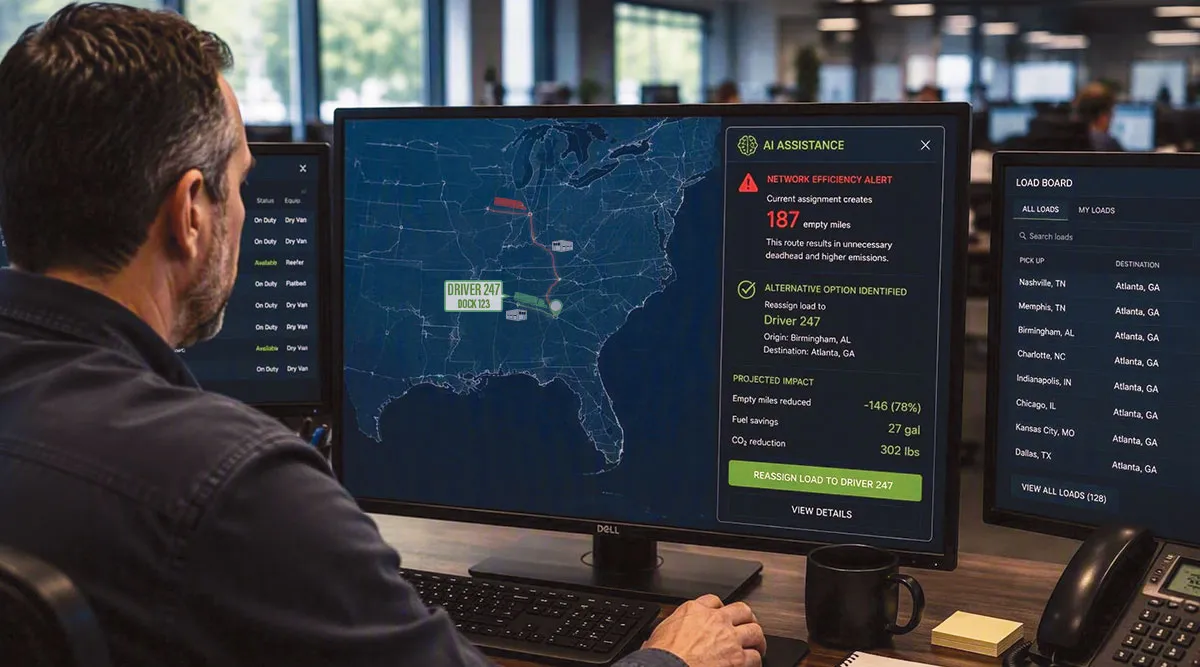
Manual planning tends to focus on the next move: covering the next load, solving the next problem, keeping today on track. Our Decision Automation Platform operates differently. It evaluates the entire network at once, continuously matching assets to loads with an understanding of how each decision affects what comes next. That broader perspective reduces inefficiency almost immediately.
The reason is downstream awareness. Automated decision-making accounts for where trucks need to be next, not just where they are now. Instead of reacting to gaps as they appear, decisions are made with future positioning in mind. Fewer reactive assignments mean fewer empty miles — and far less local optimization that creates waste elsewhere in the network.
At Grand Island Express, the team reached an automated decision adoption rate of greater than 80%, unlocking a number of benefits for the organization.
“Through automation, we can handle more volume with the same staff and focus on decisions that truly make us invaluable to our customers and drivers,” said Deen Albert, VP of Operations at Grand Island Express.
Automation changes how decisions ripple through the network. And once that shift takes hold, the system starts to consistently deliver greater efficiency.
Download the full Grand Island Express case study.
2. Revenue Quality Improves Alongside Utilization
On its own, moving more freight doesn’t guarantee better outcomes. What matters is which freight fills the network and why those decisions are made.
This is where the Optimal Dynamics platform starts to deliver bottom-line results. As utilization improves, automation adds discipline to freight selection. Instead of filling gaps with whatever volume is available, fleets begin prioritizing freight that aligns with margin targets, service commitments, and long-term network health. The operation stops chasing coverage for its own sake and starts operating with intent.
That shift happens because profitability becomes both visible and actionable at the lane level. Optimal Dynamics’ Decision Automation Platform evaluates tradeoffs continuously — not just whether a load fits, but whether it contributes to overall network value. Decisions optimize for margin, not just movement. Short-term fixes that erode long-term performance fade away, replaced by choices that hold up week after week.
At Leonard’s Express, replacing manual decisions with automated load planning led to a greater than 5% increase in revenue per total mile, as well as other positive results.
“With smarter and more disciplined load planning, we had a 45% reduction in brokerage-booked loads, improving asset utilization and the quality of revenue in our network,” said Kyle Johnson, CEO of Leonard’s Express.
Not all revenue is created equal. With decision automation in place, fleets are able to plan loads that drive greater profitability for the organization.
Download the full Leonard’s Express case study.
3. Planner Roles Evolve
When Optimal Dynamics automates repetitive decisions, planners no longer spend their days stitching together spreadsheets, reacting to last-minute issues, or re-solving the same problems over and over.
What surfaces instead is the work that actually benefits from human judgment: managing exceptions, strengthening customer and driver relationships, and contributing to strategic decisions that shape the network.
This shift matters because firefighting is both exhausting and unsustainable. When planners are overwhelmed, everything slows down, communication suffers, alignment breaks down among teams, and even strong organizations feel reactive.
Automation removes the constant pressure of routine decision-making. With fewer manual decisions competing for attention, planners regain focus, teams align more easily around shared objectives, and the organization operates with greater clarity because people aren’t buried under volume.
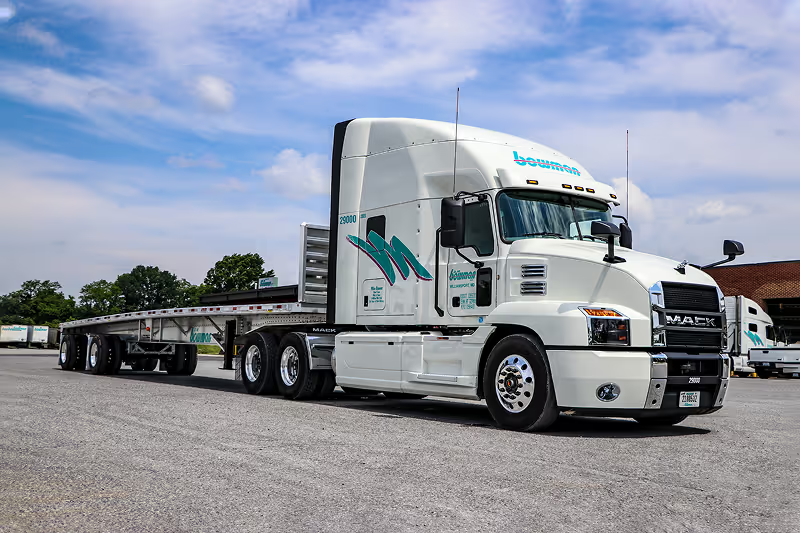
At D.M. Bowman, decision automation enabled a fundamental rethinking of how planning work was structured. Planning was consolidated from five independent divisions into a unified model, allowing the team to focus less on repetition and more on impact. As their leadership described the shift:
“We’re disrupting the normal way of trucking around here,” said Samantha Bodnar, President at D.M. Bowman. “But everyone’s bought into it, and I do think that's going to revolutionize and take us the next 65 years.”
D.M. Bowman’s results underscore an important point: Planner productivity is the natural outcome when a system is designed to let people do the work only humans can do.
Download the full D.M. Bowman case study.
4. Networks Become More Resilient
This is where Optimal Dynamics’ Decision Automation Platform makes its greatest impact. When decisions are automated, the system continuously re-evaluates tradeoffs as conditions shift and adjusts assignments with the same discipline it applies on a “normal” day. Instead of relying on last-minute fixes, the network absorbs change and stabilizes faster. This is true when:
- Demand spikes
- Capacity tightens
- Disruptions occur
- Other unexpected dynamics emerge
Automation enables continuously updated decisions, each informed of how a change affects the rest of the operation. That reduces cascading failures, the kind where one reactive decision creates three new problems downstream. When disruption hits, the system responds quickly and consistently, keeping the network aligned around shared objectives.
Standard Logistics implemented decision automation to better manage its rapid expansion while maintaining efficiency and service levels. The platform helped the company increase revenue per driver (despite a down market), reduce empty miles across its over-the-road operations, and improve planning efficiency.
“No human can possibly see these opportunities or make all these decisions network-wide,” said Eric Hernandez, Manager of Fleet Optimization & Customer Service at Standard Logistics. “With the level of automation provided by Optimal Dynamics, now we can.”
True operational resilience emerges when decisions are made consistently and at scale by systems built to handle uncertainty.
Download the full Standard Logistics case study.
Bringing it Together: Why These Changes Compound
It’s tempting to look at outcomes like better utilization, stronger revenue quality, more focused planners, and a more resilient network — and treat each as a separate win. In reality, they’re tightly connected.
Automating load planning and dispatch decisions creates a more efficient foundation. That efficiency supports better freight selection, which raises the quality of revenue moving through the network. As decisions become more consistent and less reactive, planners are freed from constant firefighting and able to focus on higher-value work. With fewer manual interventions and clearer priorities, the network becomes more stable and better equipped to handle volatility.
Each improvement reinforces the next.
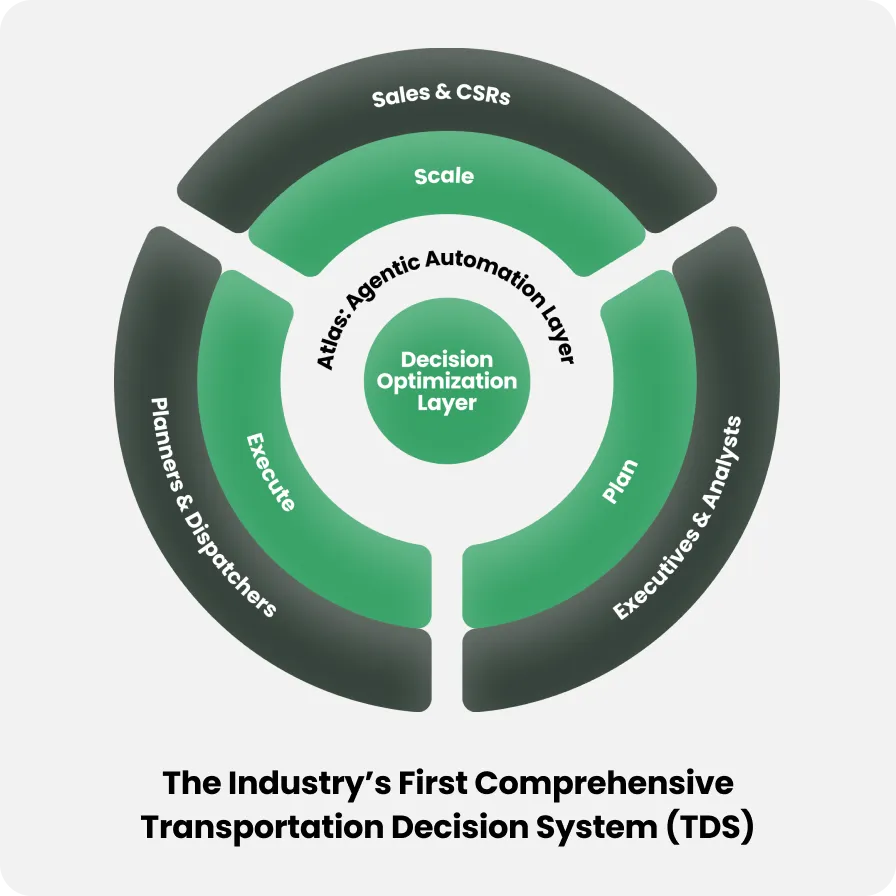
This is why decision automation scales in a way manual processes can’t. Human-led planning can produce strong results in pockets, but those results are hard to replicate consistently as complexity increases. The Optimal Dynamics Decision Optimization Engine applies the same logic, objectives, and discipline across the entire network — every day, under every condition.
See How Fleets Made the Shift
The shift to decision automation is all about changing how decisions are made at scale, so that any fleet can continue to perform as complexity increases.
Contact us for a live walkthrough of how decision automation can be adopted in your fleet — from first steps to sustained impact.