

A Day in the Life of a CSR: From Reactive Load Booking to Proactive Network Strategy
By the time the first cup of coffee hits the desk, the inbox is already full for a customer service representative (CSR) in the trucking industry.
Overnight tender requests are stacked up. Load boards sit open across multiple tabs. Slack messages from dispatch flag coverage gaps from yesterday. Service issues haven’t fully cleared. Management wants revenue up and driver utilization higher. The freight market is still tight. Margins are thinner. Shippers have leverage. Brokers are aggressive. Spot rates move without warning.
The day starts fast — and CSRs immediately fall into reaction mode.
Every tender acceptance decision feels urgent. Every load sourcing workflow runs in parallel. Freight procurement strategy becomes survival strategy. Accept what you can. Figure it out later.
But booking freight without real visibility into carrier network balance, commitments, and overall performance and profitability impact, has consequences. Deadhead creeps up. Service falters days later. Dispatch replans. The impact surfaces long after the decision is made.
The hardest part isn’t finding freight. It’s knowing which freight actually improves the network.
That’s the trap. And it’s this freight network optimization problem that Scale was built to solve.
Here’s a look at a day in the life of a CSR, and how Scale, the industry’s first Decision-Native Agentic System™ (DNAS), redefines the role and how CSRs operate.
Stepping Out of the Accept-Everything Trap
At the start of a day, most CSRs immediately step into the accept-everything trap. Visibility is fragmented with no dynamic view of load balance across the fleet. Teams rely on manually maintained spreadsheets that are outdated the moment they’re saved. Dashboards show what happened last week rather than what’s developing tomorrow. There’s no real-time inbound versus outbound view, and there’s no clear fleet capacity forecast for the days ahead.

Because most carriers approach freight procurement on a load-by-load basis rather than viewing the network holistically, CSRs are making decisions in isolation. A load looks profitable, and it fits on paper, so it gets accepted. Instead of freight network optimization, you fall into the accept-everything trap.
Only later does the imbalance show up:
- Overbooking builds in dense lanes.
- Underbooking surfaces in weaker regions.
- Driver deadhead increases.
- Service failures emerge.
- Dispatch replans.
- Excess freight gets brokered out at a lower margin to protect commitments.
All of it traces back to a decision that made sense in the moment — but that lacked network-wide context.
External pressure only exacerbates this problem. With margins compressed due to the years-long freight recession, brokerage firms are bidding aggressively. External load boards often carry lower profitability, while shippers scrutinize service performance and reject bids when consistency slips.
In this environment, CSRs are making the best decisions possible, but those high-stakes decisions are being made without complete freight network visibility and balance.
The Network Comes Into View With Scale
A CSR’s day once meant tabs, tenders, and building pressure as the inbox fills with an unmanageable amount of new messages. But imagine how the day might be different with a solution like Scale.
Instead of scanning individual loads, Scale sees the network:
- Inbound volume stacked against outbound commitments.
- Over-booked lanes flagged early.
- Under-booked regions clearly identified.
- Forecasted gaps days out (not discovered after the fact).
- Capacity mapped through driver PTAs.
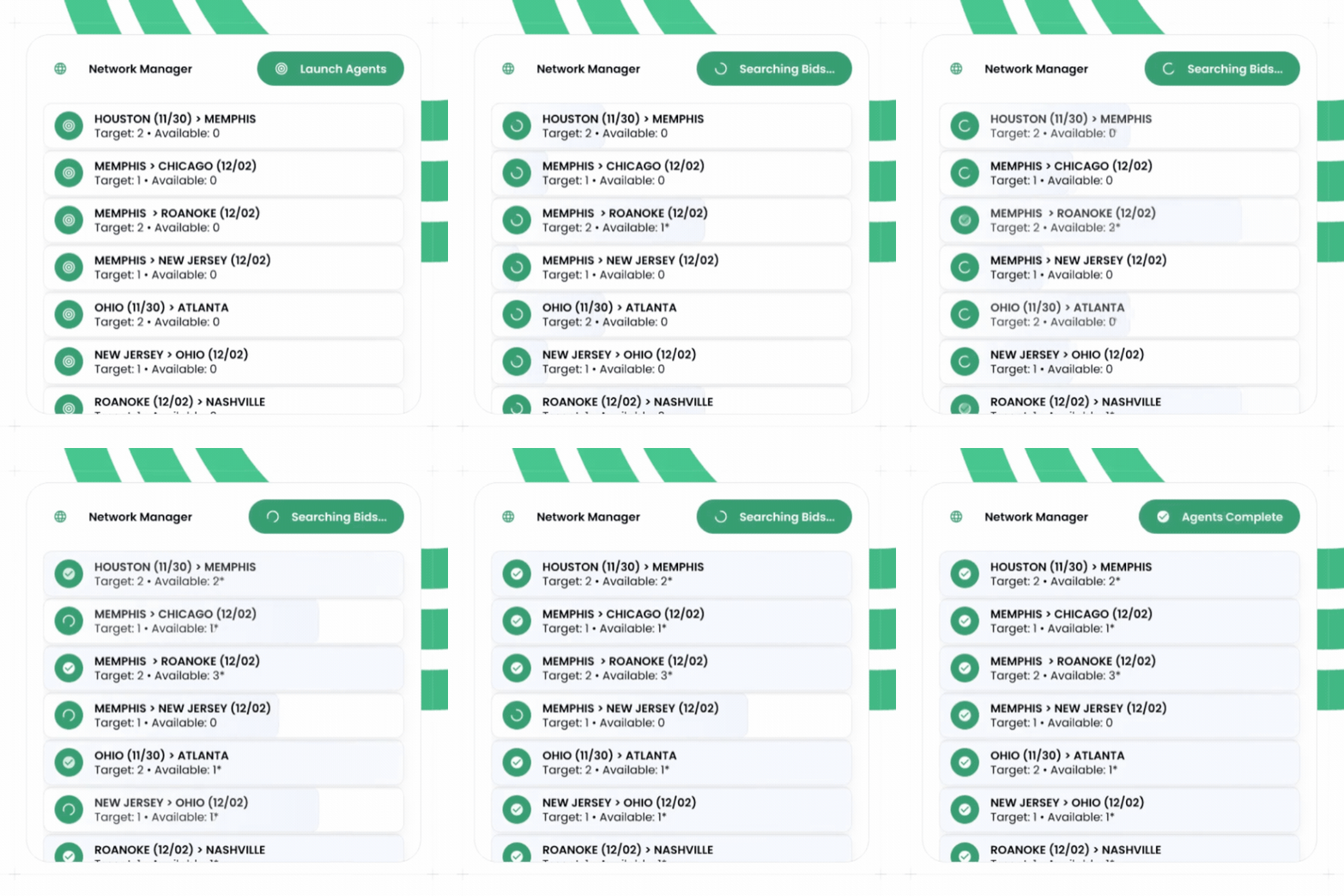
With Scale in place, the new CSR workflow includes a ranked view of “Loads to Target.” These target loads represent freight the network actually needs, rather than just what’s available.
Scale continuously evaluates where freight is needed, where imbalance is forming, and where profitability can improve — before those issues surface operationally. The optimization engine determines what the network needs. From there, automated load sourcing, bidding, negotiating, and procuring align directly to that need. Every action supports the carrier’s need for network optimization, and the load / tender acceptance process becomes forecast-informed.
Executing With Intention
Old workflows meant CSRs spent a disproportionate amount of time refreshing load boards, working the tender management process, chasing coverage, and hoping nothing critical slipped through the cracks.
With a Decision-Native Agentic System in place, this looks different. The CSR is focused on higher-leverage work:
- Managing shipper conversations
- Reviewing performance metrics
- Preparing for sales calls
- Lane profitability analysis and strategy
At the same time, Scale is autonomously working in the background 24/7.
It searches load boards continuously, monitors inbound tenders as they arrive, evaluates each opportunity against real-time network needs and profitability targets, negotiates where appropriate, declines freight that would create imbalance or profit erosion, and aggregates opportunities across channels into a single execution layer aligned with carrier network optimization.
Scale reduces a CSR’s cognitive load by eliminating constant manual scanning and increasing confidence in every tender acceptance decision.
The results are measurable: freight is booked faster in competitive markets, driver utilization improves, average rate per mile strengthens, service failures decline, and carriers can increase loaded miles per driver while reducing driver deadhead.
Turning Visibility Into Revenue
CSRs often spend just as much time explaining freight as booking it.
- Why was this lane overcommitted?
- Why did service slip in this region?
- Why did margin erode on freight that looked acceptable just this morning?
Without clear visibility, conversations are often reactive. Now, with Scale, the CSR can proactively reach out to shippers in lanes where capacity is developing. They can accept tenders further out with confidence because future coverage is visible. Appointment windows can be adjusted strategically to secure freight that fits the network. And excess loads can be brokered out intentionally — not as a last-minute correction, but as part of a deliberate freight margin optimization exercise.
As Karen Smerchek, President at Veriha Trucking, put it, the opportunity is to move “from reactive decision-making to a system that continuously tells us where freight is needed ahead of time, and then works the market to secure it” enabling carriers to achieve dynamic load balancing and remain profitable as conditions change.
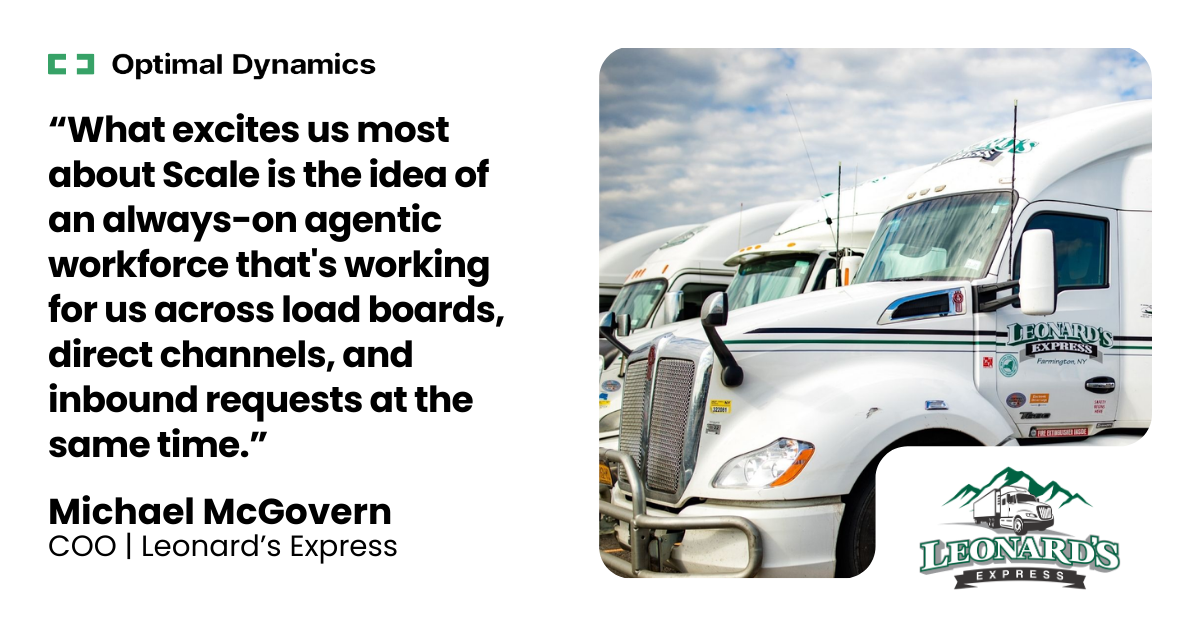
Michael McGovern, Chief Operating Officer at Leonard’s Express, highlighted the impact of an “always-on agentic workforce” that aggregates freight across channels and acts autonomously without requiring constant intervention.
When a freight sourcing workflow becomes network-aware, shipper relationships become strategic. This allows for revenue growth focused on balance, service, and long-term performance rather than short-term volume.
Reaping the Benefits of a Role Redefined
Under the old model, success was measured by how much freight got booked. The work was constant searching, rapid-fire tender acceptance decisions, reactive problem solving, and managing the consequences of choices made without full visibility. It was cognitively heavy work — the kind that leaves teams exhausted, even when they’ve done everything right.
With a solution like Scale, the CSR position has been redefined.
When decision-native freight procurement is in place, the CSR is no longer buried in transactional load booking. One becomes a network steward who can focus on strategic revenue growth rather than just volume while freight is procured proactively, service is protected intentionally, and shippers are engaged with data-backed confidence.
Freight procurement becomes a strategic, autonomous function rather than a transactional one.
The cognitive overload fades because the system handles continuous evaluation and execution. What remains is higher-value work: strengthening relationships, identifying growth opportunities, and guiding the network toward balance and profitability.
Completing the Transportation Decision System
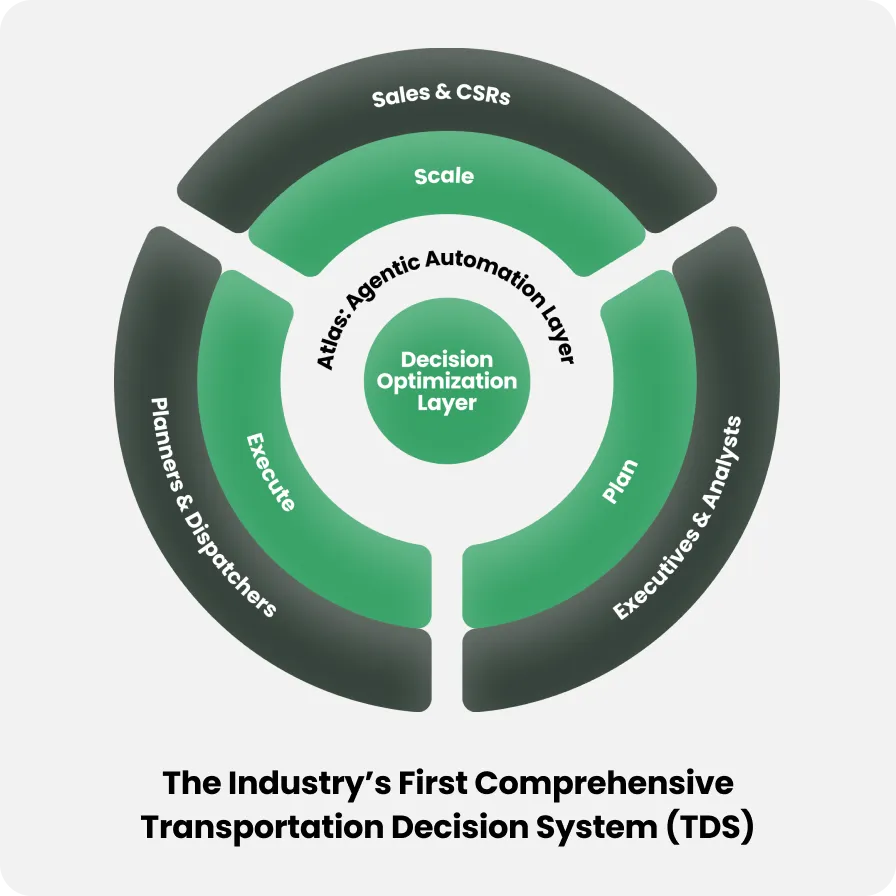
For years, carriers have had pieces of the puzzle: planning tools, dashboards, and execution systems. But what they’ve needed is a platform that syncs truck capacity planning, network optimization, and freight execution in one place.
As the third component of Optimal Dynamics’ Transportation Decision System (TDS), Scale evaluates carrier networks holistically, identifies imbalances early and takes action deliberately rather than reactively.
Most agentic AI tools respond to requests. They operate in isolation and optimize locally — one load, one workflow, and one transaction at a time.
Scale starts at the network level. It determines what the fleet actually needs to stay balanced and profitable. Then it executes intentionally, aligning freight procurement with service performance, driver utilization optimization, and margin goals. Optimization decides, and then agents act.
When those two functions are tightly connected, growth is no longer separated from operational discipline. Freight procurement becomes proactive, network balance becomes continuous, and the CSR role evolves alongside a system built to support it.
Discover what decision-native execution looks like in practice when you schedule a demo.